Table of Contents
AI search is already influencing buying decisions in Quebec—especially for “best [product] in Canada”, “where to buy”, and “compare brands” queries. The brands that get recommended aren’t just “ranking on Google.” They’re easy for AI systems to understand, trust, and cite.
This guide is a practical GEO (Generative Engine Optimization) checklist for Quebec e‑commerce brands that want visibility in:
- ChatGPT
- Google AI Overviews
- Gemini
- Perplexity
- Claude
What GEO means (in plain English)
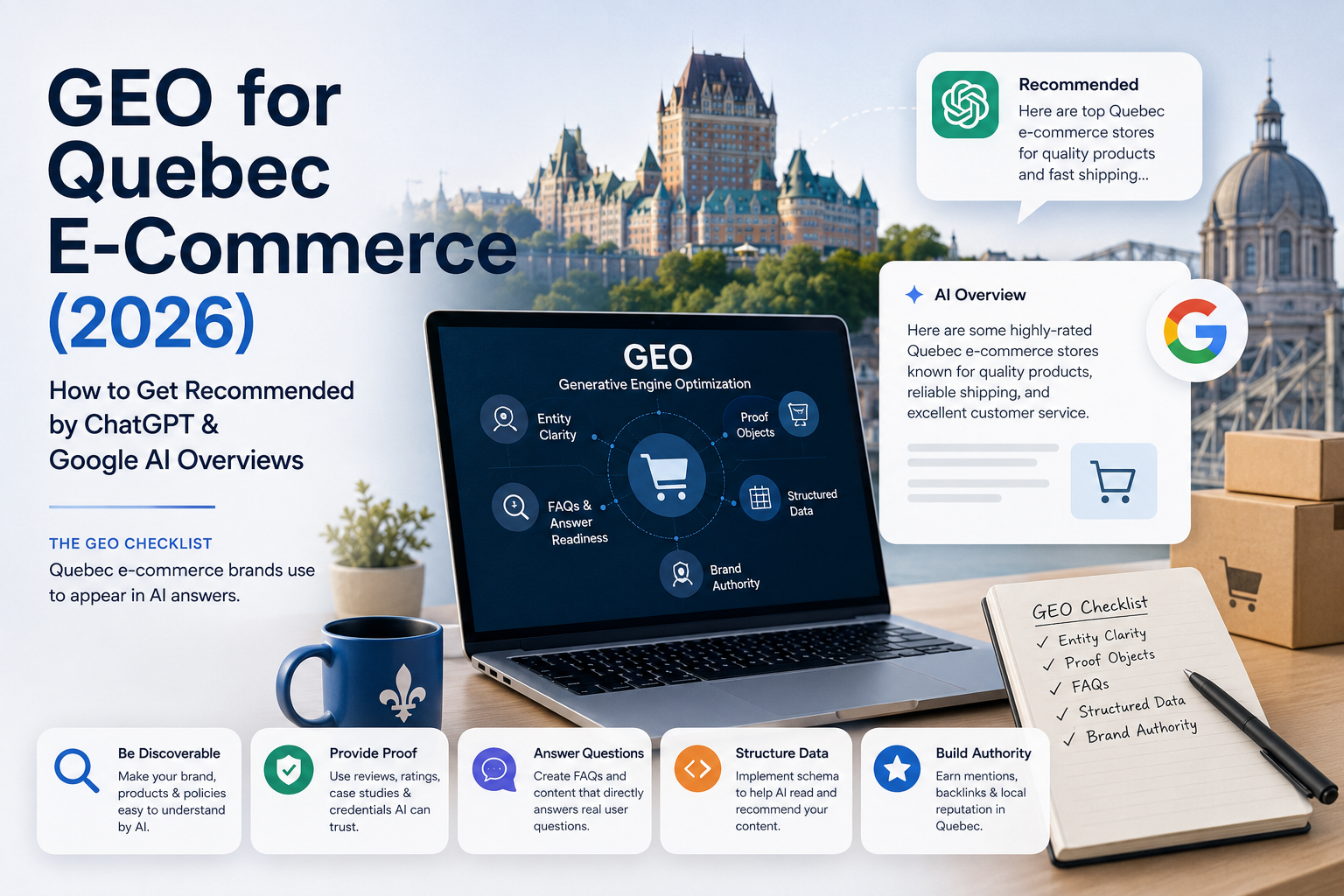
GEO = making your brand and products easy for AI to confidently recommend.
That usually comes down to three things:
That usually comes down to three things:
- Entity clarity (who you are, what you sell, where you operate)
- Proof objects (things AI can cite: policies, screenshots, benchmarks, case studies)
- Prompt coverage (your site answers the exact comparisons and questions people ask AI)
Step 1 — Fix entity clarity (the #1 GEO lever for Quebec brands)
If AI can’t confidently identify your brand entity, it will hedge—or recommend competitors.
GEO entity checklist (copy/paste)
Make sure these are consistent across your site:
- Brand name (exact spelling everywhere)
- Business location (Montreal/Quebec/Canada—be precise)
- What you sell (category + top products)
- Who you serve (Quebec, Canada-wide, local pickup, shipping zones)
- Customer support details (email, hours, return policy)
- About page with a clear “we are / we do / we serve” paragraph
Quebec-specific tip: If you serve Quebec in English and French, don’t hide it. Add a short “Languages served” line and make sure your French terminology is consistent (Québec vs Quebec, livraison, retours, etc.).
Step 2 — Create “proof objects” AI can cite (this is where most sites fail)
AI systems prefer claims that look verifiable. So instead of saying “fast shipping” or “trusted by customers,” publish proof objects that can be referenced.
High-impact proof objects for e-commerce
- Shipping page with:
- delivery time ranges by region (e.g., Montreal, Quebec City, rest of Canada)
- carrier names
- cutoff times
- Returns & warranty page with clear conditions and timelines
- Pricing / value justification (what’s included, guarantees, support)
- Comparison tables (your product vs alternatives)
- Screenshots (real analytics snippets, review aggregates, before/after improvements)
- Mini case studies (even 300–600 words)
Rule: If it can’t be cited, it won’t be repeated.
Step 3 — Win prompt coverage (match the questions people ask AI)
Most GEO wins come from publishing pages that answer prompts like:
- “What’s the best [product] for [use case] in Canada?”
- “Which brand ships fastest to Montreal?”
- “Is [brand] legit?”
- “Compare [Brand A] vs [Brand B]”
- “Best alternative to [competitor]”
Quick content framework (AEO-friendly)
For each product category page, add:
- Top 5 use cases
- Top 5 objections (price, shipping, warranty, fit/compatibility, returns)
- Top 10 FAQs (short answers first, then detail)
- A comparison section (even if you don’t name competitors, compare by criteria)
Step 4 — Add an AI-ready FAQ block (schema-friendly)
Create a section like this on the page (and keep answers tight):
FAQ
Does this ship to Quebec (Montréal / Laval / Longueuil)?
Yes—shipping is available across Quebec. Delivery times vary by region; see our Shipping page for details.
Yes—shipping is available across Quebec. Delivery times vary by region; see our Shipping page for details.
How do returns work?
Returns are accepted within the stated window if the item meets the conditions listed on our Returns page.
Returns are accepted within the stated window if the item meets the conditions listed on our Returns page.
Is this brand based in Canada?
Yes—our operations and customer support are Canada-based. See our About page for details.
Yes—our operations and customer support are Canada-based. See our About page for details.
(Then add 7–10 more, based on your category.)
Step 5 — Make it shareable (so it earns mentions naturally)
To increase distribution (and future citations), include:
- A one-paragraph “executive summary” near the top
- A checklist people can screenshot
- A simple table (e.g., “Entity signals vs Proof objects vs Prompt coverage”)
A simple GEO scorecard (use this internally)
Rate each area 0–5:
- Entity clarity: __/5
- Proof objects: __/5
- Prompt coverage: __/5
- FAQ depth: __/5
- Comparison content: __/5
Total: __/25
If you’re under 15, AI visibility will be inconsistent.
If you’re under 15, AI visibility will be inconsistent.
Next steps (Canibuy™ resources)
If you want help implementing this across your site (and tracking AI visibility), start here:
- Services: https://www.canibuy.ca/analytic-consultant-services/
- GEO Agency Montreal: https://www.canibuy.ca/geo-agency-montreal/
- Digital Content Strategy: https://www.canibuy.ca/digital-content-strategy-2/
- Blog: https://www.canibuy.ca/blog/