Table of Contents
Introduction
For nearly two decades, brand visibility online meant one thing above all else: ranking on Google. Businesses invested heavily in SEO — optimizing keywords, earning backlinks, refining page speed — all in pursuit of that coveted spot on page one of search results.
That playbook isn’t dead. But it’s no longer the whole story.
A new behavior has quietly become mainstream: people are asking AI systems directly for answers, recommendations, and comparisons. Instead of typing a query into Google and scrolling through ten blue links, users are asking ChatGPT “what’s the best CRM for a small business,” or asking Google’s AI Overview to summarize the pros and cons of a product category, or asking Perplexity to compare vendors. The AI reads across the web, synthesizes an answer, and presents it — often citing only a handful of sources, sometimes citing none at all visibly to the user.
If your brand isn’t one of those sources, you don’t just rank lower. You disappear entirely from that interaction, regardless of how well-optimized your website is for traditional search.
This shift has given rise to a new discipline: AIO — AI Optimization.
What is AIO?
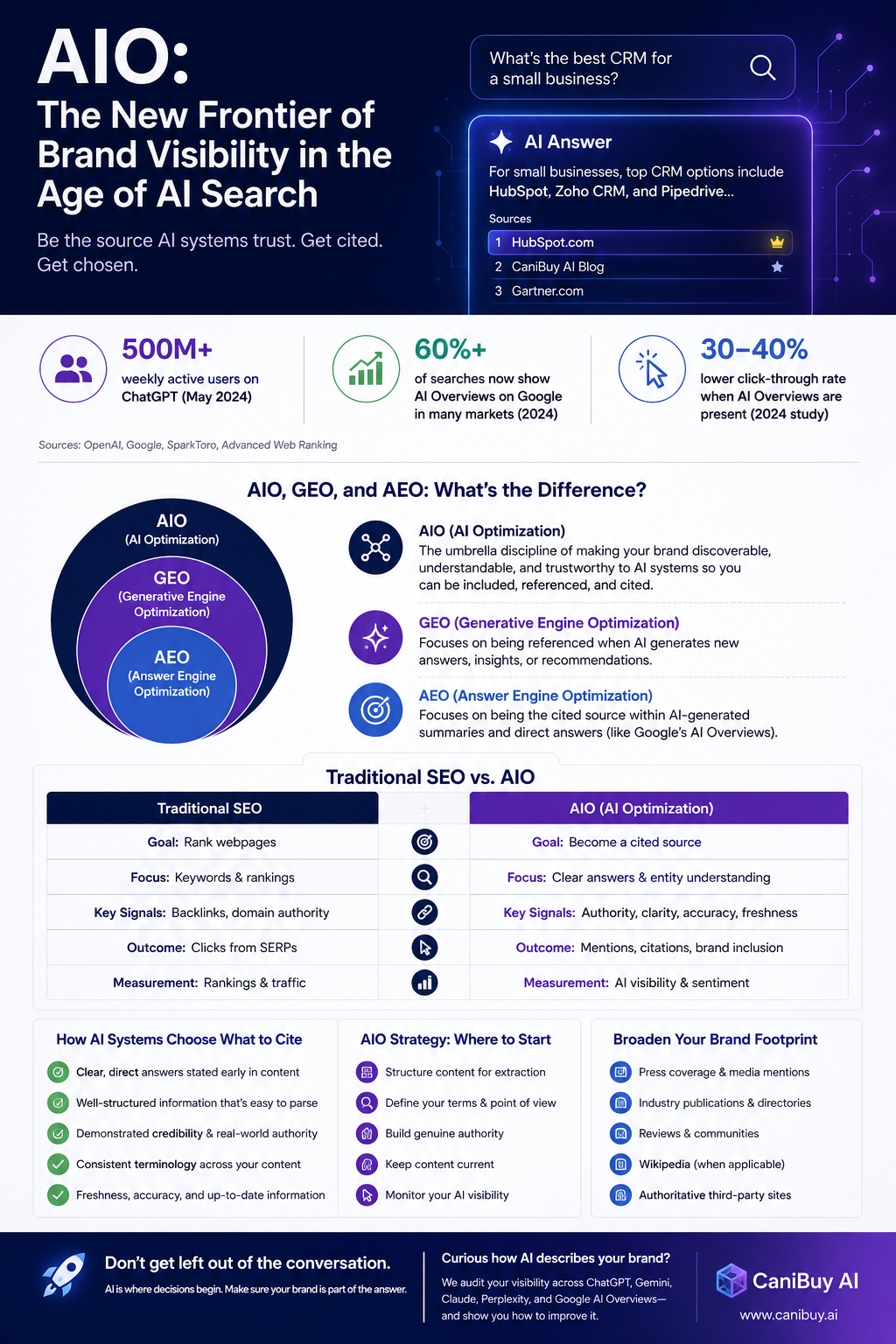
AIO refers to the practice of structuring, writing, and positioning your brand’s content so that AI systems — including large language models, AI-powered search engines, and generative answer tools — can easily find it, understand it, trust it, and cite it.
It’s best understood as an umbrella term. Underneath it sit two more specific, and increasingly familiar, tactics:
GEO (Generative Engine Optimization) focuses on optimizing content so AI models are more likely to reference it favorably when generating new answers — for example, when someone asks an AI to explain a topic or compare products, and the AI writes a fresh response drawing on what it has learned or retrieved.
AEO (Answer Engine Optimization) focuses on getting your content featured as the direct, cited answer inside AI-generated summaries — such as Google’s AI Overviews, where a specific source is quoted or linked as the origin of a fact.
Some organizations use these terms interchangeably; the industry vocabulary is still settling, and you’ll encounter other acronyms too (LLMO, AISO, and others) describing overlapping ideas. But regardless of the label, the underlying goal is consistent: be the source that AI systems trust enough to use.
Why This Matters Right Now
Three shifts are driving the urgency behind AIO:
1. AI is becoming the first touchpoint, not the last. Increasingly, people ask an AI assistant before they ever visit a website. That means brands risk losing the opportunity to make a first impression — the AI’s summary becomes the customer’s entire understanding of a product or service before a single click happens.
2. Being cited is becoming the new “being recommended.” When an AI names your brand in its answer, it functions similarly to a trusted referral. Conversely, when a competitor is cited instead of you — even if your website objectively has better content — that competitor gains the credibility boost in the eyes of the user.
3. Traditional SEO strength doesn’t guarantee AI visibility. Ranking well in classic search results is still valuable, but it is not sufficient on its own. AI systems evaluate content differently — favoring clarity, structure, directness, and demonstrable authority — which means a page can perform well in Google’s organic results while still being overlooked by an AI Overview or a chatbot’s synthesized response.
How AI Systems Actually Choose What to Cite
Unlike traditional search engines, which primarily rank pages using signals like backlinks and keyword relevance, generative AI systems assess content more like a researcher skimming for the clearest, most trustworthy source on a topic. In practice, that tends to mean they favor:
- Clear, direct answers stated early in a piece of content, rather than answers buried under long introductions
- Well-structured information — headers, defined terms, organized lists — that’s easy to parse and extract
- Demonstrated credibility, such as citing data, being referenced elsewhere, or having clear authorship and expertise
- Consistent terminology across a brand’s content, rather than shifting language from page to page
- Freshness and accuracy, particularly for fast-moving topics where outdated information is a liability
Building an AIO Strategy: Where to Start
AIO isn’t a replacement for SEO — it’s a layer built on top of it. A few practical starting points:
Structure content for extraction. Write clear, standalone answers to common questions your audience asks, positioned near the top of relevant pages rather than buried in narrative text.
Define your terms. If your brand uses specific terminology, concepts, or a distinct point of view, spell it out clearly and consistently. AI systems are more likely to reuse language they can confidently attribute and understand.
Build genuine authority. Original research, clear expertise, and credible sourcing all increase the odds that an AI system treats your content as trustworthy enough to cite.
Keep content current. AI systems are increasingly sensitive to freshness, particularly on topics where facts change quickly (pricing, product features, industry data).
Monitor your AI visibility. A growing number of tools now track how often — and how accurately — your brand is mentioned across AI platforms like ChatGPT, Gemini, and Perplexity, much the way analytics tools have long tracked traditional search rankings.
The Bigger Picture
The terminology around this space — AIO, GEO, AEO — will likely keep evolving as the technology and industry mature. What won’t change is the underlying shift already well underway: a growing share of how people discover, evaluate, and choose brands is happening inside AI-generated conversations rather than traditional search results pages.
Brands that treat this shift seriously today — building content that’s structured, credible, and genuinely useful to both humans and AI systems — will be positioned to stay visible as this new landscape continues to take shape. Those that wait may find themselves optimized for a search engine while invisible to the AI that’s increasingly standing in front of it.
This article was prepared by CaniBuy AI. Interested in understanding where your brand stands in AI-generated search and how to improve your visibility? Get in touch with our team.