Table of Contents
Search engines are evolving. And this time, it’s not just an algorithm update — it’s a fundamental shift in how people find information.
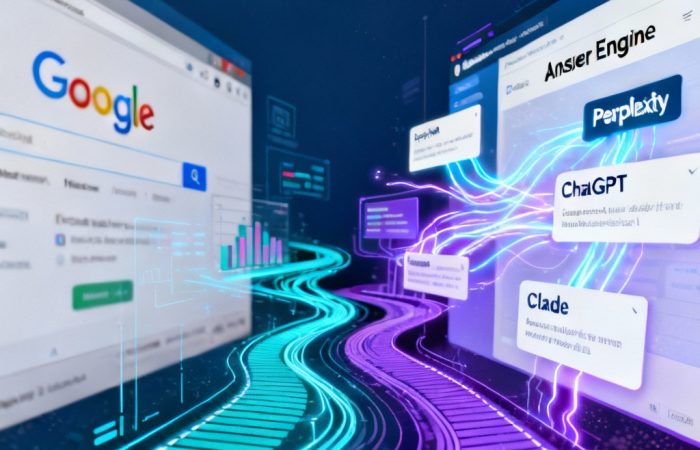
Perplexity, ChatGPT, Claude, Google AI Overviews: answer engines are no longer a distant trend. In 2026, they’re completely reshaping search traffic. And if you don’t adapt your strategy now, you’re going to lose visibility.
The good news? It’s not too late. Here’s how to stay visible when the rules of the game change.
The problem: your traditional SEO is no longer enough
For years, SEO was simple: you ranked well on Google, you got traffic. The rules were clear.
But today, even if you’re on Google’s first page, a user might never click on your site. Why? Because they ask their question to Perplexity or ChatGPT and get their answer directly, without leaving the app.
Answer engines do cite your content, that’s true. But they summarize it, synthesize it, integrate it into a broader answer. Your traffic? It decreases. Your authority? It gets diluted.
And what’s even more problematic: these engines cite sources selectively. Ranking well for a keyword on Google no longer means you’ll be visible for that same query on an answer engine.
The reality in 2026: there are two battles
Battle #1: Dominate Google (still relevant) Google remains dominant, but its share is shrinking. Answer engines are capturing more and more queries, especially complex and informational searches.
Battle #2: Be chosen by answer engines (a new game) Perplexity, ChatGPT, and others work differently. They favor credible, well-structured, and up-to-date sources. Ranking well on Google isn’t enough — you need to be citable.
The winning strategy in 2026? Dominate both.
How to dominate answer engines: 4 concrete tactics
1. Become the go-to source for your subject
Answer engines cite sources they consider most trustworthy and relevant for a given question.
How? Create content that answers exactly the questions your users are asking. Not general SEO content — content that answers a specific question, clearly, and better than the competition.
Example: Instead of “The Complete Guide to Digital Marketing,” create “Why Your SEO Strategy Fails with Answer Engines (And How to Fix It).”
Answer engines seek the best answer, not the best ranking. If your content is the clearest, most structured, most useful answer — you’ll be cited.
2. Structure your content to be cited
Answer engines don’t scan your site like a human does. They look for clear structures: definitions, verifiable facts, structured data.
Use:
- Hierarchical headings (H1, H2, H3) — they aid comprehension
- Lists and tables for factual information
- Structured data (schema.org) for facts and dates
- Short, direct paragraphs — avoid dense blocks of text
The easier your content is to extract for an AI, the more likely you’ll be cited. It’s counterintuitive, but true: clarity = visibility on answer engines.
3. Update regularly and stay current
Answer engines favor recent and up-to-date content. An article from 2023 about 2026 trends? It will never be cited.
Update your key articles regularly. You don’t need to rewrite them — just add:
- The latest data and statistics
- Recent developments
- Corrections if the landscape has changed
“Fresh” content = 3x higher probability of being cited by answer engines.
4. Diversify your traffic sources
In 2026, relying solely on Google traffic is risky. You also need to:
- Generate direct traffic (email, social media) — this strengthens your authority
- Be present where answer engines find content (blogs, articles, public resources)
- Build your brand — if people search for you by name, you win regardless of where they find the information
A site that receives direct and social traffic is considered more authoritative by answer engines. It’s an indirect signal, but a powerful one.
The real difference in 2026
Successful agencies understand that SEO hasn’t disappeared — it’s evolved. It’s no longer just “how do I rank on Google.” It’s “how do I stay visible in a fragmented search landscape where Google, Perplexity, ChatGPT, and others compete for attention.”
This requires a hybrid strategy:
- Traditional SEO (for Google, still relevant)
- Answer engine optimization (for Perplexity, ChatGPT, etc.)
- Brand building and direct traffic
- Current and well-structured content
Brands that do both win. Those who ignore answer engines gradually lose visibility.
What now?
If your marketing strategy still relies exclusively on Google SEO, 2026 is the year to evolve.
Canibuy helps brands in Montreal navigate this transition. We optimize for Google, but also for answer engines — because that’s the reality of search in 2026.
Ready to adapt your strategy? Let’s talk about how to stay visible when the rules change.
Contact us for a search strategy built for 2026.